
Goethe University Frankfurt, Germany, 3-5 September 2026
The fourteenth edition of the Mnemonics summer school will be hosted by the Frankfurt Memory Studies Platform (FMSP) and will be held in person at Goethe University Frankfurt, Germany, from Thursday 3 September 2026 to Saturday 5 September 2026.
The annual Mnemonics summer school brings together junior and senior scholars in the interdisciplinary field of memory studies, affording PhD students from around the world the opportunity to receive extensive feedback on their ongoing projects and to catch up with methodological and theoretical debates in memory studies. Each edition features three keynote events and 24 PhD student presentations. Each PhD student will be assigned a senior respondent from a partner institution who will provide an in-depth commentary on their paper. Mnemonics is a unique platform for learning, mentoring, and networking specifically designed to meet the needs and interests of the next generation of memory scholars.
Keynote Speakers
- Aleida Assmann (University of Konstanz)
- Silvana Mandolessi (KU Leuven)
- Christina Morina (Bielefeld University)
Participating Mnemonics Partners and Friends
- Tea Sindbæk Andersen (University of Copenhagen)
- Lucy Bond (University of Westminster)
- Stef Craps (Ghent University)
- Rick Crownshaw (Goldsmiths, University of London)
- Sara Dybris McQuaid (Aarhus University)
- Astrid Erll (Goethe University Frankfurt)
- Victoria Fareld (Stockholm University)
- Brett Ashley Kaplan (University of Illinois Urbana-Champaign)
- Susanne Knittel (Utrecht University)
- Silvana Mandolessi (KU Leuven)
- David Mwambari (KU Leuven)
- Jessica Ortner Nielsen (University of Southern Denmark)
- Jessica Rapson (King’s College London)
- Anna Reading (King’s College London)
- Michael Rothberg (UCLA)
- Hans Ruin (Södertörn University, Stockholm)
- Hanna Teichler (Goethe University Frankfurt)
- Alexander Ulrich Thygesen (Aarhus University)
- Barbara Törnquist-Plewa (Lund University)
- Johanna Vollmeyer (Complutense University, Madrid)
- Lena Wetenkamp (KU Leuven)
Theme
The 2026 Mnemonics summer school will address the relationship between memory and the future. Remembering is not just an activity concerned with the past, but just as much—and perhaps even more so—with the present and future. As historian Reinhart Koselleck (1979) has already argued in the 1970s, a society’s “space of experience” shapes its “horizon of expectation.” Recent research in the psychology of memory suggests an integrated “Remembering-Imagining-System” (Conway et al. 2016), where present acts of recall—both individual and collective—shape “future thinking” and vice versa (Szpunar & Szpunar 2016).
Questions of how we imagine the future have gained particular urgency in recent times: Climate change looms large (Craps, Crownshaw & Dolgoy 2025), whilst democracies and transitional societies appear to be backsliding into different forms of authoritarianism (Wertsch 2021; Morina 2026). Many societies grapple with the legacies and impact of colonialism, which often manifest as “continuous pasts” (Adebayo 2023). Wars are raging worldwide.
Another reason to pay closer attention to the nexus between memory and the future is major transformations in the digital realm, especially the uses of social media for memory-making worldwide and the arrival of generative AI (Mandolessi 2023; Merrill et al. 2025). How does the advent of AI challenge the way we will ‘do’ memory in the future? Might AI be the future of collective memory (Gensburger & Clavert 2024)?
How can memory become a resource for the future, even a medium of hope (Rigney 2025)? To what extent can societies “learn from the past” (Gensburger & Lefranc 2020)? And, conversely, where does memory inhibit imagining and acting differently, for example because it remains tied to the modern time regime (Assmann 2020), continues to draw on toxic (colonial and other) archives, implicitly primes us to do “more of the same” (Erll 2022), or has ossified into exclusionary cultures of remembrance (Rothberg 2022)? What types of discourse, media, and art can help envision alternative futures and reflect on the temporalities and mnemonic regimes that we unthinkingly inhabit? By the same token, we also invite participants to reflect on the future of memory studies. What new concepts, methodologies, and practices are required to carry the field into the future?
The 2026 Mnemonics summer school invites PhD students to critically engage with these questions through interdisciplinary dialogue. Participants will reflect on key challenges of addressing the relationship between memory and the future, both through case studies and through theoretical explorations.
Contributions may address a wide range of topics, including, but not limited to:
- the power of literature, film, and the arts to represent alternative temporalities, thus “breaking up time” (Bevernage & Lorenz 2013) and questioning the “modern time regime” (Assmann 2020)
- the shifting relations between presentism, past-orientation, and future-orientation (Hartog 2015)
- the future-thinking and future-making potential of particular media genres (e.g., climate change fiction; Craps, Crownshaw & Dolgoy 2025)
- environmental memory and the future (Gülüm et al. 2024)
- indigenous and Global South temporalities (Kennedy & Silverstein 2023)
- queer temporalities, (post-)memories, and the future (Freeman 2010; Çalışkan 2019)
- archives and the future (Stoler 2016; Salerno & Rigney 2004)
- anxiety about the future and pre-TSD (pre-traumatic stress disorder) in life and literature (Batiashvili et al. 2025; Craps 2026)
- the “hidden power of implicit collective memory” (Erll 2022) and the way it preforms future forms of experiencing, remembering, and acting
- the problematic phenomenon of “memory before violence” (Buckley-Zistel et al. 2024)
- how existent forms of commemoration enable or limit future acts of solidarity (e.g., the “historians’ debate 2.0” about memories of the Holocaust, colonialism, and the Israeli-Palestinian conflict; Rothberg 2022)
- how remembering on social media, the platformization of memory, and AI co-create our futures (Mandolessi 2023; Merrill et a. l 2025; Smit in Erll & Hirst 2026)
- narratological approaches to memory and future thinking in literature (D’Amato 2025; Milevksi & Wetenkamp 2022; Teichler 2026)
- interdisciplinary explorations (e.g., where psychological, sociological, and cultural studies approaches to “future thinking and transformative memory” meet; Erll & Hirst 2026)
Format
The summer school will include keynote lectures, general discussions, and professional development sessions. The main emphasis, however, is on the presentation of PhD work in progress in the form of panels of three students who each give a 15-minute talk that is based on their ongoing research while also relevant to the theme of this year’s summer school. In order to foster feedback and discussion, each panel will include an extensive response and a Q&A session.
Practical Information
Local Organizers
Mnemonics 2026 is hosted by the Frankfurt Memory Studies Platform. The organizing team consists of Prof. Dr. Dr. h.c. Astrid Erll, Dr. Hanna Teichler, Konstantina Tsoleridou, and Bhagyashri Vyasaramacharya (all Goethe University Frankfurt).
Where?
The summer school will be held at Goethe University Frankfurt, Campus Westend. Frankfurt am Main International Airport (FRA) is less than an hour away. International trains arrive at Frankfurt am Main Hbf and Frankfurt Süd (a 15-minute subway ride from the university).
When?
The summer school will commence on the morning of Thursday 3 September 2026 and conclude on the afternoon of Saturday 5 September 2026.
Fees
Mnemonics 2026 will not charge any participation fees, but participants will have to arrange and cover their travel to Frankfurt as well as overnight accommodation. Participants can draw from a contingent of twin rooms in a nearby hotel. The rate is €115.50 per person for the full stay of three nights (total, not per night), breakfast excluded. This rate assumes a shared twin room with two separate beds. The organizers will offer a service to bring together participants who wish to share such a room, and will also cover all lunches and the summer school dinner.
Applications
Applications are open to all PhD students with an interest in memory studies who are actively enrolled at the time of the summer school. Half of the 24 available spots are reserved for students affiliated with Mnemonics partner institutions. Attendance is in-person only.
To apply, please submit the following via this portal by 15 March 2026:
- a 300-word abstract for a 15-minute paper (including the title, your name, and your institutional affiliation)
- a brief description of your PhD research project (one paragraph)
- a short bio
Important Dates
- Application deadline: 15 March 2026
- Notification of acceptance: 15 April 2026
- Deadline for paper submission: 24 August 2026
Questions?
Please email MnemonicsFrankfurt [at] gmail [dot] com.
Relevant Links
- Mnemonics website: https://www.mnemonics.ugent.be/
- Mnemonics on Facebook: http://www.facebook.com/groups/mnemonics.network/
- Mnemonics on Bluesky: @mnemonics.bsky.social
References
- Adebayo, Sakiru. 2023. Continuous Pasts. Frictions of Memory in Postcolonial Africa. Ann Arbor: University of Michigan Press.
- Assmann, Aleida. 2020 [2013]. Is Time Out of Joint?: On the Rise and Fall of the Modern Time Regime. Ithaca, NY: Cornell UP.
- Batiashvili, Nutsa, Meymune Nur Topçu and James V. Wertsch. 2025. “Memory and Anxiety: A Sociocultural Approach: Introduction to the Special Collection.” Memory, Mind & Media 4 (2025): e9. https://doi.org/10.1017/mem.2025.10004
- Bevernage, Berber and Chris Lorenz, eds. 2013. Breaking Up Time: Negotiating the Borders between Present, Past, and Future. Göttingen: Vandenhoek & Ruprecht 2013.
- Buckley-Zistel, Susanne, Kaya de Wolff, Astrid Erll, Sybille Frank, Nicolai Hannig, Sabine Mannitz Mariel Reiss, Jona Schwerer, Sara-Luise Spittler, and Monika Wingender. 2024. “Memory Before Violence.” TraCe Working Paper5, Frankfurt/M . DOI: 10.48809/PRIFTraCeWP2405
- Çalışkan, Dilara. 2019. “Queer Postmemory.” European Journal of Women’s Studies 26 (3): 261–73. https://doi.org/10.1177/1350506819860164.
- Conway, Martin A., Catherine Loveday, and Scott N. Cole. 2016. “The Remembering-Imagining System.” Memory Studies 9 (3): 256–265. https://doi.org/10.1177/1750698016645231
- Craps, Stef. 2026. “Trauma of Tomorrow: Environmental Breakdown, Affect, and Cultural Narratives,” in Erll & Hirst 2026.
- Craps, Stef, Rick Crownshaw and Rebecca Dolgoy. 2025. “Introduction – Climate Witnessing: Memory, Mediation and the More-than-Human.” Memory Studies Review, 2(2), 103-125. https://doi.org/10.1163/29498902-20250201
- D’Amato, Gabriele (2025) “Multiperspective Fictions and the Implicated Narrator.” Ticontre Teoria TestoTraduzione 23: 123-142. (https://teseo.unitn.it/ticontre/article/view/3537/3969)
- Erll, Astrid (2022) ‘The Hidden Power of Implicit Collective Memory’ Memory, Mind & Media 1.e14: 1–17. DOI: https://doi.org/10.1017/mem.2022.7
- Erll, Astrid and William Hirst, eds. 2026. Cognition, Culture, and Political Momentum. Breaking down the Silos in Collective Memory Research. New York: Oxford UP 2026. (Esp. the chapters in section 7: “Future Thinking and Transformative Memory”) https://global.oup.com/academic/product/cognition-culture-and-political-momentum-9780197788332?cc=de&lang=en&#
- Freeman, Elizabeth. 2010. Time Binds: Queer Temporalities, Queer Histories. Duke University Press. https://doi.org/10.2307/j.ctv1198v7z
- Gensburger, Sarah, and Sandrine Lefranc. 2020. Beyond Memory: Can We Really Learn from the Past? Palgrave.
- Gensburger, Sarah and Frederic Clavert, eds. 2024. Is Artificial Intelligence the Future of Collective Memory? Special issue of the Memory Studies Review 1 (2). https://doi.org/10.1163/29498902-202400019
- Gülüm, Erol, Paul Leworthy, Justyna Tabaszewska & Hanna Teichler, eds. 2024. Memory and Environment. Special issue of the Memory Studies Review 1 (1). https://doi.org/10.1163/29498902-20240007
- Gutman, Yifat, Brown, Adam D., and Amy Sodaro, eds. 2010. Memory and the Future: Transnational Politics, Ethics and Society. Basingstoke: Palgrave Macmillan. https://doi.org/10.1057/9780230292338
- Hartog, François. 2015. Regimes of Historicity: Presentism and Experiences of Time. Translated by Saskia Brown. New York: Columbia University Press.
- Kaplan, Brett Ashley, ed. 2023. Critical Memory Studies: New Approaches. London: Bloomsbury. https://doi.org/10.5040/9781350233164
- Kennedy, Rosanne & Ben Silverstein. 2023. “Beyond Presentism: Memory Studies, Deep History and the Challenges of Transmission.” Memory Studies 16(6), 1609-1627. https://doi.org/10.1177/17506980231203645
- Koselleck, Reinhart. 2004 [1979]. Futures Past: On the Semantics of Historical Time. Translated by Keith Tribe. Cambridge, MA: MIT Press.
- Mandolessi, Silvana. 2023. “The Digital Turn in Memory Studies.” Memory Studies 16 (6): 1513-1528. https://doi.org/10.1177/17506980231204201
- Merrill, Samuel, Mykola Makhortykh, Silvana Mandolessi, Victoria Grace Richardson-Walden, Rik Smit, and Qi Wang. “Handling the Hype: Demystifying Artificial Intelligence for Memory Studies.” Memory, Mind & Media 4 (2025): e18. https://doi.org/10.1017/mem.2025.10018
- Milesvki, Urinana and Lena Wetenkamp (2022) “Introduction: Relations between Literary Theory and Memory Studies”. In Journal of Literary Theory XVI. 2 (2022): 197-212. https://doi.org/10.1515/jlt-2022-2022
- Morina, Christina. 2026. Das amerikanische Beben. Erfahrungen und Konsequenzen für die deutsche Demokratie. München: Siedler.
- Rigney, Ann. 2025. Remembering Hope. The Cultural Afterlife of Protest. New York: Oxford UP. https://fdslive.oup.com/www.oup.com/academic/pdf/openaccess/9780197789711.pdf
- Rothberg, Michael. 2022. “Lived Multidirectionality: ‘Historikerstreit 2.0’ and the Politics of Holocaust Memory.” Memory Studies 15 (6): 1316-1329. https://doi.org/10.1177/17506980221133511
- Salerno Daniele and Ann Rigney, eds. 2024. Archiving Activism in the Digital Age. Amsterdam: Institute of Network Cultures. https://networkcultures.org/blog/publication/archiving-activism-in-the-digital-age/
- Stoler, Ann L. Duress. 2016. Colonial Durabilities in Our Times. Durham/London: Duke UP.
- Szpunar, Piotr M. and Karl K. Szpunar. 2016. “Collective Future Thought: Concept, Function, and Implications for Collective Memory Studies.” Memory Studies 9 (4): 376–389. https://doi.org/10.1177/1750698015615660
- Teichler, Hanna. 2026. “Fictions of Transoceanic Memory,” in Erll & Hirst 2026.
- Wertsch, James V. 2021. How Nations Remember: A Narrative Approach. New York: Oxford UP.
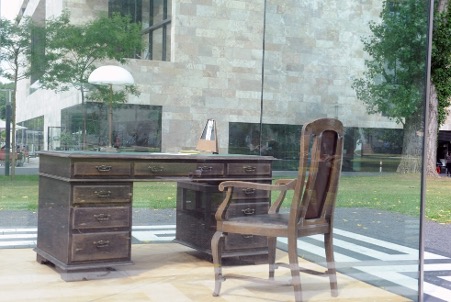
Header image: Adorno Memorial at Goethe University Frankfurt (Image rights: Uwe Dettmar, Goethe University Frankfurt)

